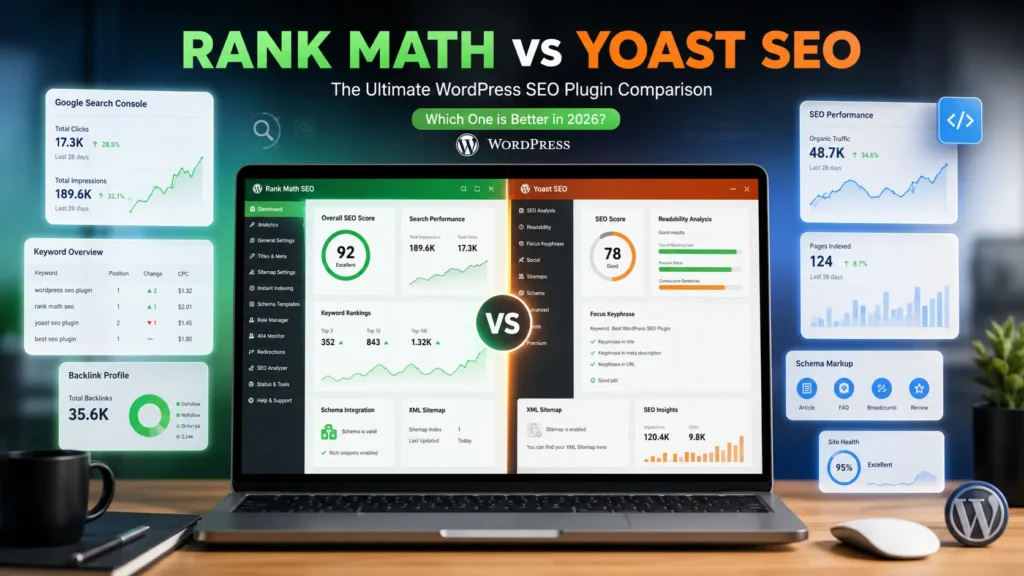
Rank Math vs Yoast SEO: The Complete 2026 Comparison
If you run a WordPress site, you have almost certainly typed “Rank Math vs Yoast SEO” into Google at some point. Both plugins promise the same outcome, better rankings, cleaner technical SEO, and an easier writing experience, but they get there in different ways. I have installed and configured both plugins on dozens of client sites over the years, migrated sites in both directions, and dealt with the quirks each one brings. This guide is built from that hands-on experience rather than a quick feature-list comparison.
By the end of this Rank Math vs Yoast SEO comparison, you will know exactly which plugin fits your site, your budget, and your workflow. I am not going to declare one plugin a universal winner, because the right answer depends on whether you are a beginner blogger, an agency managing dozens of client sites, or a WooCommerce store owner who needs solid product schema. Pricing and feature sets change over time, so always confirm the latest details on the official Rank Math and Yoast websites before making a purchase decision.
Quick Verdict: Rank Math vs Yoast SEO at a Glance
If you want the short version of this Rank Math vs Yoast comparison before diving into the details, here it is. Rank Math generally wins on free-tier features, schema flexibility, and value for money, especially for bloggers and affiliate marketers who do not want to pay for basics. Yoast SEO wins on long-term brand trust, a more beginner-friendly content analysis interface, and deeper WooCommerce-specific tooling once you are on the bundled Premium plan.
Category | Better Choice | Why It Matters |
Free version depth | Rank Math | More schema types and unlimited focus keywords in the free plan |
Beginner-friendliness | Yoast SEO | Simpler traffic-light content analysis, less overwhelming for new users |
Pricing | Rank Math | Lower cost for unlimited personal websites |
WooCommerce SEO | Yoast SEO | Dedicated WooCommerce SEO plugin with deep product schema support |
Schema Markup | Rank Math | Built-in schema generator with more types in the free version |
AI features | Both (close) | Both now offer AI-assisted titles, meta descriptions, and optimization |
Brand trust and ecosystem | Yoast SEO | Longer track record, larger install base, deep WordPress integration |
Keep this table in mind as a starting point, not a final answer. The rest of this Rank Math vs Yoast SEO breakdown walks through each category in detail so you can match the plugin to your actual workflow rather than a generic recommendation.
What is Rank Math?
Rank Math is a WordPress SEO plugin launched in 2018 by the team at MyThemeShop. It positioned itself from day one as the plugin that gives away more for free than competitors charge for. In practice, this means the free version of Rank Math includes features like unlimited focus keywords per post, built-in schema markup for over a dozen content types, a redirect manager, and a 404 monitor, all of which are usually paywalled in other plugins.
Rank Math’s setup wizard imports settings directly from Yoast SEO, All in One SEO, and a handful of other plugins, which is one reason so many site owners switch over when comparing Rank Math vs Yoast SEO for the first time. The plugin also includes a built-in Google Search Console connection in the free tier, something that used to be a premium-only feature on most competing plugins.
Rank Math Pro adds keyword rank tracking inside the WordPress dashboard, Content AI for writing assistance, advanced schema templates, and deeper WooCommerce SEO tools. The Business and Agency tiers scale these features up for freelancers and agencies managing multiple client websites.
What is Yoast SEO?
Yoast SEO has been around since 2008, making it one of the oldest and most trusted names in WordPress SEO. Built originally by Joost de Valk, the plugin popularized the idea of a simple traffic-light content analysis system, where green, orange, and red indicators tell you how well a post is optimized for both SEO and readability before you hit publish.
Yoast was acquired by Newfold Digital in 2021, which also owns Bluehost. That acquisition has not changed the core plugin much, but it has deepened Yoast’s integration with Bluehost hosting packages. The free version of Yoast SEO covers the fundamentals well: meta titles and descriptions, XML sitemaps, basic schema, and the readability analysis that the plugin is famous for.
Yoast SEO Premium unlocks multi-keyword optimization, a redirect manager, internal linking suggestions, AI-generated titles and descriptions, and access to the Yoast Academy training courses. Premium also bundles in the Local SEO, Video SEO, and News SEO add-ons, which used to be sold separately. For WooCommerce stores, Yoast offers a dedicated WooCommerce SEO plugin with product-specific schema and sitemap handling.
Feature Comparison Table: Rank Math vs Yoast SEO
This side-by-side feature comparison table is the fastest way to scan the practical differences between the two plugins. Use it as a quick reference, then read the detailed sections below for context on why each difference matters for your specific use case.
Feature | Rank Math | Yoast SEO |
Focus keywords (free) | Unlimited | One per post |
Schema types (free) | 15+ built in | Basic schema only |
Setup wizard | Step-by-step, imports settings | Step-by-step, simpler |
Google Search Console | Built into free version | Not included |
Redirect manager | Free version included | Premium only |
404 monitor | Free version included | Not available |
Content AI / writing assistant | Pro plan | Premium plan |
Keyword rank tracking | Pro plan | Not built in |
WooCommerce SEO | Pro plan | Separate paid plugin |
Local SEO module | Pro plan | Included in Premium bundle |
Internal linking suggestions | Pro plan (Link Suggestions) | Premium plan |
Multi-keyword optimization | Available in free version | Premium only |
Pricing for unlimited personal sites | Lower | Higher (per-site licensing) |
User Interface Comparison
The user interface is where day-to-day opinions on Rank Math vs Yoast SEO diverge the most. Rank Math uses a modular dashboard with a Setup Wizard, a clean module-toggle screen, and an on-page content analysis panel that sits in the WordPress sidebar or below the editor, depending on your layout preference.
Yoast SEO’s interface is simpler and more visually guided. The traffic-light system for SEO and readability scores is instantly recognizable, even to someone who has never touched an SEO plugin before. New users tend to find Yoast slightly less intimidating on the first few posts, while experienced users often find Rank Math’s interface faster once they know where everything lives.
From a practical standpoint, Rank Math packs more settings into more screens, which can feel like a learning curve at first but pays off once you need granular control. Yoast keeps things deliberately minimal, trading some flexibility for approachability.
Setup Wizard Comparison
Both plugins walk you through an initial setup wizard, but they take different approaches. Rank Math’s wizard asks about your website type, connects Google Search Console and Analytics directly, and offers to import settings and 301 redirects from your previous SEO plugin in one pass. This import feature alone has saved hours when migrating client sites and is a major factor whenever the Rank Math vs Yoast SEO migration question comes up.
Yoast’s setup wizard is shorter and focuses on the essentials: site type, organization or person details for schema, and social profile links. It gets you running quickly but leaves more configuration for later, inside the plugin’s settings tabs.
- Rank Math setup wizard: connects Search Console, imports from other plugins, configures schema defaults in one flow.
- Yoast SEO setup wizard: faster to complete, fewer decisions up front, more settings to configure later.
Keyword Optimization
Keyword optimization is the core job of any SEO plugin, and this is a category where the Rank Math vs Yoast SEO debate gets genuinely close. Rank Math’s free version allows unlimited focus keywords per post, with a content analysis checklist that checks keyword placement in the title, slug, meta description, first paragraph, and image alt text.
Yoast SEO restricts focus keyword tracking to one keyword in the free version, with multi-keyword support reserved for Premium. Yoast’s analysis goes a step further on language processing for supported languages, recognizing different word forms and synonyms of your keyphrase, which can make the suggestions feel more natural in English, Dutch, German, and several other supported languages.
In testing across client sites, Rank Math’s free multi-keyword support is the more practical advantage for affiliate marketers and bloggers who frequently target keyword clusters rather than a single phrase. Yoast’s linguistic analysis is genuinely well built, but you need the Premium tier to access it for more than one term.
Schema Markup
Schema markup is one of the clearest differentiators in any Rank Math vs Yoast SEO comparison. Rank Math built its schema generator to be a core part of the free plugin, offering structured data templates for articles, products, recipes, FAQs, how-tos, local businesses, events, courses, and more, all without a paid upgrade.
Yoast SEO includes basic schema in the free version, primarily organization and article markup, with more advanced and custom schema types gated behind Premium and the specialized add-ons like Local SEO or WooCommerce SEO. If structured data and rich snippets are a priority for your content strategy, Rank Math’s free schema generator gives you a meaningful head start without spending anything.
AI Features
AI tooling is the newest battleground in the Rank Math vs Yoast SEO race, and both plugins have moved quickly here. Rank Math’s Content AI helps generate SEO-friendly titles, meta descriptions, and on-page content suggestions, with credits included on the Pro plan and higher allowances on Business and Agency tiers.
Yoast SEO has rolled out its own AI features, including AI-generated titles and meta descriptions, AI-powered content optimization suggestions, and a newer AI Brand Insights tool that monitors how a brand appears across AI platforms like ChatGPT and Google Gemini. These features are part of Yoast SEO Premium and the expanded Yoast SEO AI+ package.
Neither plugin’s AI toolset replaces a real content strategy. Treat AI suggestions in both Rank Math and Yoast as a faster first draft, not a finished product. If your workflow involves AI-assisted writing, it is worth reading Writora’s guide on
humanizing AI-generated text before publishing, since search engines and readers both respond better to content that does not read like a template.
Performance
Plugin performance matters because a bloated SEO plugin can quietly undo the speed gains you worked hard to achieve elsewhere. Both Rank Math and Yoast SEO are reasonably efficient on modern hosting, but they are not identical under the hood. Rank Math uses a modular architecture, meaning unused modules can be switched off entirely from the dashboard, which reduces the plugin’s footprint on lighter sites.
Yoast SEO loads its content analysis engine in the post editor, which is necessary for the real-time readability and SEO checks the plugin is known for. On lower-spec shared hosting, some users notice a small delay when the editor first loads, though this is rarely significant on decent hosting infrastructure.
Neither plugin will single-handedly make or break your Core Web Vitals scores. Server quality, caching, theme bloat, and image optimization will have a far bigger impact than the choice between Rank Math and Yoast SEO. Do not invent or trust unverified speed benchmarks online; test both plugins on your own staging environment if speed is a major concern.
Speed Impact
Specifically on front-end speed impact, both plugins are lightweight by design since most of their processing happens in the WordPress admin area, not on the public-facing pages visitors load. Rank Math’s modular toggle system lets you disable features like the 404 monitor, redirections, or local SEO if you are not using them, trimming the plugin down further.
Yoast SEO does not offer the same granular module toggling in the free version, though Premium users can disable specific add-ons like Video SEO or News SEO if they are not relevant. For most sites, the practical speed difference between Rank Math and Yoast SEO on the front end is negligible once proper caching is in place.
WooCommerce SEO
WooCommerce SEO is one area where the Rank Math vs Yoast SEO decision can genuinely tip in Yoast’s favor. Yoast’s dedicated WooCommerce SEO plugin, bundled into Premium, was purpose-built for product pages: it generates rich product schema with price, availability, and review data, creates ecommerce-friendly sitemaps that exclude cart and checkout pages, and gives tailored content analysis for product descriptions.
Rank Math’s WooCommerce SEO module, available on Pro and higher plans, also covers product schema, variation handling, and global identifiers like GTINs and SKUs. It is a capable toolset, but Yoast’s WooCommerce-specific plugin has a slightly longer track record with larger stores and tends to get mentioned more often by experienced WooCommerce developers.
If your site is primarily an online store, weigh this category heavily in your Rank Math vs Yoast SEO decision. For a content-first or affiliate site with only a handful of product pages, either plugin’s WooCommerce tools will be more than sufficient.
Local SEO
Local SEO support differs mainly in how it is packaged. Rank Math’s Local SEO module, available on the Pro plan, lets you add business information, opening hours, geo-coordinates, and local business schema directly from the plugin’s settings, plus support for multiple business locations on higher tiers.
Yoast bundles its Local SEO add-on into the Premium package at no extra cost, covering similar ground: business schema, Google Maps embedding, opening hours, and multi-location management for businesses with more than one storefront. For a single local business website, both plugins handle the basics competently, so the deciding factor usually comes down to which plugin you are already using for everything else.
Image SEO
Image optimization is often overlooked, but it plays a meaningful role in overall on-page SEO. Rank Math’s content analysis checks whether your focus keyword appears in at least one image’s alt text and file name, flagging missing alt attributes directly in the editor. The plugin also supports automatic image sitemaps out of the box.
Yoast SEO performs similar alt text and keyword checks within its content analysis, though it places slightly less emphasis on image-specific scoring compared to Rank Math. Neither plugin compresses or resizes images, so you will still need a dedicated image optimization plugin or a CDN with image processing for file size reduction.
Internal Linking
Internal linking tools are a Pro and Premium feature on both plugins. Rank Math’s Link Suggestions module, available from Pro upward, scans your published content and suggests relevant internal links to add while you write, based on shared keywords and topics. Yoast’s internal linking suggestions, part of Premium, work in a similar fashion, surfacing related posts and pages as you write a new article.
Both tools save real time once your site has more than a few dozen posts, since manually remembering every relevant past article becomes impractical. Neither linking tool is a substitute for a deliberate site structure and pillar-cluster content strategy, but they are a helpful safety net for catching missed linking opportunities.
Redirect Manager
Redirect management is a clear win for Rank Math in this Rank Math vs Yoast SEO comparison. Rank Math includes a full redirect manager, supporting 301, 302, and 307 redirects, directly in the free version, along with automatic redirect suggestions when you change a post’s URL slug.
Yoast SEO’s redirect manager is locked behind Premium. If you rename URLs often, restructure categories, or migrate content regularly, and you are not ready to pay for Yoast Premium, Rank Math’s free redirect manager alone can be a deciding factor in the Rank Math vs Yoast SEO debate.
XML Sitemap
Both plugins generate clean, search-engine-friendly XML sitemaps automatically, splitting large sitemaps into smaller indexed files as your content grows. Rank Math allows more granular control over which post types, taxonomies, and individual posts are included or excluded from the sitemap, all from the free version.
Yoast SEO’s sitemap settings are simpler and cover the essentials: post types, taxonomies, and author archives can be toggled on or off, with less granular per-post control than Rank Math offers. For most sites, either sitemap implementation works well with Google Search Console without any manual intervention.
Google Search Console Integration
This is one of the more underrated differences in the Rank Math vs Yoast SEO comparison. Rank Math connects to Google Search Console directly inside the free plugin, pulling impressions, clicks, and indexing data into the WordPress dashboard without needing a separate analytics plugin.
Yoast SEO does not offer a built-in Search Console integration; you will need to check performance data directly in Search Console or pair Yoast with a separate analytics plugin. If having search performance data inside your WordPress dashboard matters to your workflow, Rank Math has the more convenient setup out of the box.
Free vs Premium
Comparing Rank Math Free vs Pro and Yoast Free vs Premium side by side is one of the most practical ways to decide where your money should go. Rank Math’s free version is unusually generous, covering schema, redirects, Search Console integration, and unlimited keywords, features that many competitors reserve for paid tiers.
Yoast’s free version covers the SEO fundamentals well but holds back redirects, multi-keyword optimization, internal linking suggestions, and AI features for Premium subscribers. If budget is your main constraint, Rank Math’s free tier will get a small blog or business site further than Yoast’s free tier will.
What You Get Free | Rank Math Free | Yoast SEO Free |
Redirect manager | Yes | No (Premium only) |
Schema markup | 15+ types | Basic article/organization |
Multi-keyword support | Yes | No (Premium only) |
Search Console data in dashboard | Yes | No |
Content readability analysis | Yes | Yes |
XML sitemaps | Yes | Yes |
Pricing Comparison
Pricing is one of the most frequently searched parts of any Rank Math vs Yoast SEO comparison, and it is also the part most likely to change. The figures below reflect publicly listed pricing at the time of writing; introductory discounts, regional taxes, and promotional sales can shift the numbers, so always verify current pricing on the official Rank Math and Yoast websites before purchasing.
Rank Math Pro is listed at roughly $107.88 per year at standard renewal pricing for unlimited personal websites, with introductory and seasonal discounts often bringing the first-year price down meaningfully. The Business plan, suited to freelancers and small agencies managing client sites, runs around $335.88 per year, while the Agency plan for larger operations is priced near $779.88 per year. Affiliate Link – Rank Math Pro
Yoast SEO Premium is priced at $118.80 per year per website, with no monthly billing option. This is a meaningful structural difference: Yoast’s per-site licensing means costs scale linearly with the number of websites you manage, while Rank Math Pro’s unlimited personal website allowance does not. For agencies or freelancers running several sites, this difference can add up quickly in a Rank Math vs Yoast SEO cost comparison. Yoast also offers an expanded Yoast SEO AI+ package, priced around $358.80 per year, for site owners who want the full suite of AI tools alongside the core plugin. Affiliate Link – Yoast SEO Premium
Plan | Rank Math | Yoast SEO |
Free version | Yes, fully featured | Yes, fully featured |
Entry paid plan (approx.) | $107.88/year, unlimited personal sites | $118.80/year, per site |
Mid-tier plan (approx.) | $335.88/year (Business, 100 client sites) | Local/Video/News bundled into Premium |
Top-tier plan (approx.) | $779.88/year (Agency, 500+ client sites) | $358.80/year (AI+ package) |
Billing model | Annual, unlimited personal sites on Pro | Annual, per-site license |
If you are also shopping for hosting while you set this up, it is worth comparing hosting costs in the same breath. Hostinger’s managed WordPress plans start at a low introductory rate and include free SSL, automatic backups, and one-click WordPress installs, which pairs well with either SEO plugin if you are building a new site from scratch. Affiliate Link – Hostinger
Pros and Cons
Rank Math Pros
- Generous free version with schema, redirects, and Search Console integration included
- Lower-cost Pro plan covering unlimited personal websites
- Modular architecture lets you disable unused features
- Built-in 404 monitor and redirect manager from day one
Rank Math Cons
- Interface has a steeper initial learning curve due to the number of settings
- Smaller brand history compared to Yoast SEO
- Some advanced features require navigating multiple settings tabs
Yoast SEO Pros
- Long-established brand with a large support community and extensive documentation
- Simple, beginner-friendly traffic-light content analysis
- Strong dedicated WooCommerce SEO tooling
- Yoast Academy training included with Premium
Yoast SEO Cons
- Free version withholds redirects and multi-keyword optimization
- Per-site licensing gets expensive for agencies managing multiple websites
- No built-in Google Search Console data inside the dashboard
Rank Math vs Yoast for Beginners
For a complete beginner setting up their first WordPress site, the Rank Math vs Yoast for beginners question usually comes down to comfort with settings versus comfort with cost. Yoast SEO’s traffic-light system and minimal initial configuration make it slightly easier to understand in the first week of use, with less risk of feeling overwhelmed by options you do not yet understand.
That said, Rank Math’s setup wizard does most of the heavy lifting automatically, and its free version means a beginner is not tempted to upgrade just to access basic redirects or schema. Many beginners do perfectly well with either plugin; the deciding factor is often which one a tutorial, course, or mentor happened to teach them with first.
Rank Math vs Yoast for Bloggers
Bloggers and affiliate marketers tend to lean toward Rank Math in the Rank Math vs Yoast for bloggers comparison, mainly because of the free redirect manager and unlimited free keywords. Bloggers frequently rename posts, merge old content, and adjust permalinks as a site matures, and having redirects built into the free plugin avoids an unnecessary upgrade just for that one feature.
Yoast remains a solid choice for bloggers who value the readability analysis and do not mind paying for Premium once the site starts generating revenue. If your blog already uses Yoast and you are happy with it, there is rarely a strong case for switching purely based on this comparison.
Rank Math vs Yoast for Agencies
Agencies managing multiple client websites face a very different calculation than a solo blogger. In the Rank Math vs Yoast for agencies comparison, pricing structure matters as much as features. Rank Math’s Business and Agency plans are built around a fixed number of client sites at a flat annual price, which scales more predictably as a client roster grows.
Yoast SEO’s per-site licensing model means costs increase linearly with every additional client website, which can become expensive for agencies running Premium on a large number of sites. Agencies already standardized on Yoast for client deliverables and reporting consistency may still prefer to stay, but cost-conscious agencies frequently choose Rank Math specifically for this pricing structure.
Frequently Asked Questions
Which is better, Rank Math or Yoast SEO?
Neither plugin is universally better. Rank Math tends to suit bloggers, affiliate marketers, and budget-conscious users because of its generous free version and lower-cost Pro plan. Yoast SEO suits users who value a long-established brand, a simpler interface, and dedicated WooCommerce tooling. Match the plugin to your specific needs rather than looking for one universal winner.
Is Rank Math really free?
Yes. Rank Math’s free version includes schema markup, unlimited focus keywords, a redirect manager, a 404 monitor, and Google Search Console integration, all without payment. Rank Math Pro adds keyword rank tracking, Content AI, and advanced schema templates for users who want more.
Is Yoast SEO Premium worth it?
Yoast SEO Premium is worth it if you need multi-keyword optimization, redirect management, internal linking suggestions, or the bundled Local, Video, and News SEO add-ons. If you only need basic on-page optimization, the free version of Yoast SEO may be sufficient on its own.
Can I switch from Yoast SEO to Rank Math without losing my SEO data?
Yes. Rank Math’s setup wizard includes a built-in importer that transfers meta titles, descriptions, focus keywords, and redirects from Yoast SEO and several other plugins. Always back up your site before migrating, and double-check key pages after the import completes.
Does Rank Math or Yoast SEO slow down my website?
Both plugins are reasonably lightweight, and most of their processing happens in the WordPress admin area rather than on public-facing pages. Server quality, caching, and theme choice will affect your site speed far more than the choice between these two plugins.
Which plugin has better schema markup support?
Rank Math’s free version includes a wider range of built-in schema types, covering products, recipes, FAQs, how-tos, and more. Yoast SEO’s schema support is more limited in the free version, with deeper schema features available through Premium and its specialized add-ons.
Is Rank Math good for WooCommerce stores?
Rank Math’s WooCommerce SEO module, available from the Pro plan, covers product schema, variation handling, and identifiers like GTINs and SKUs. It is a capable option, though Yoast’s dedicated WooCommerce SEO plugin has a longer track record with larger ecommerce stores.
Do both plugins offer AI features?
Yes. Rank Math offers Content AI for generating titles, meta descriptions, and content suggestions on the Pro plan and above. Yoast SEO offers AI-generated titles and descriptions plus AI-powered optimization suggestions on Premium and its expanded AI+ package.
Which plugin is cheaper for managing multiple websites?
Rank Math is generally cheaper for managing multiple sites because its Pro plan covers unlimited personal websites at a flat annual price. Yoast SEO Premium uses per-site licensing, so costs increase with every additional website you manage.
Should beginners start with Rank Math or Yoast SEO?
Either plugin works well for beginners. Yoast SEO’s traffic-light interface is slightly more approachable in the first few weeks, while Rank Math’s generous free tier means beginners are less likely to feel pressured into an early upgrade. Try the free version of each on a test site before committing.
Final Verdict
After using both plugins extensively across blogs, business sites, and WooCommerce stores, the honest conclusion to this Rank Math vs Yoast SEO comparison is that there is no single correct answer for every site owner. Choose Rank Math if you want the most generous free feature set, built-in redirects and schema, and lower-cost scaling across multiple personal websites. Choose Yoast SEO if you value a long track record, a simpler interface for beginners, dedicated WooCommerce tooling, and access to structured training through the Yoast Academy.
Whichever plugin you choose between Rank Math and Yoast SEO, remember that the plugin itself is only one part of a working SEO strategy. Strong content, a clean site structure, reliable hosting, and consistent internal linking will always matter more than which logo appears in your WordPress sidebar. For more practical SEO and WordPress guidance, browse the full library of articles at
https://writora.in/, including the detailed walkthrough on humanizing AI-generated content at https://writora.in/prompts-to-humanize-ai-text/, which pairs naturally with whichever SEO plugin you settle on.